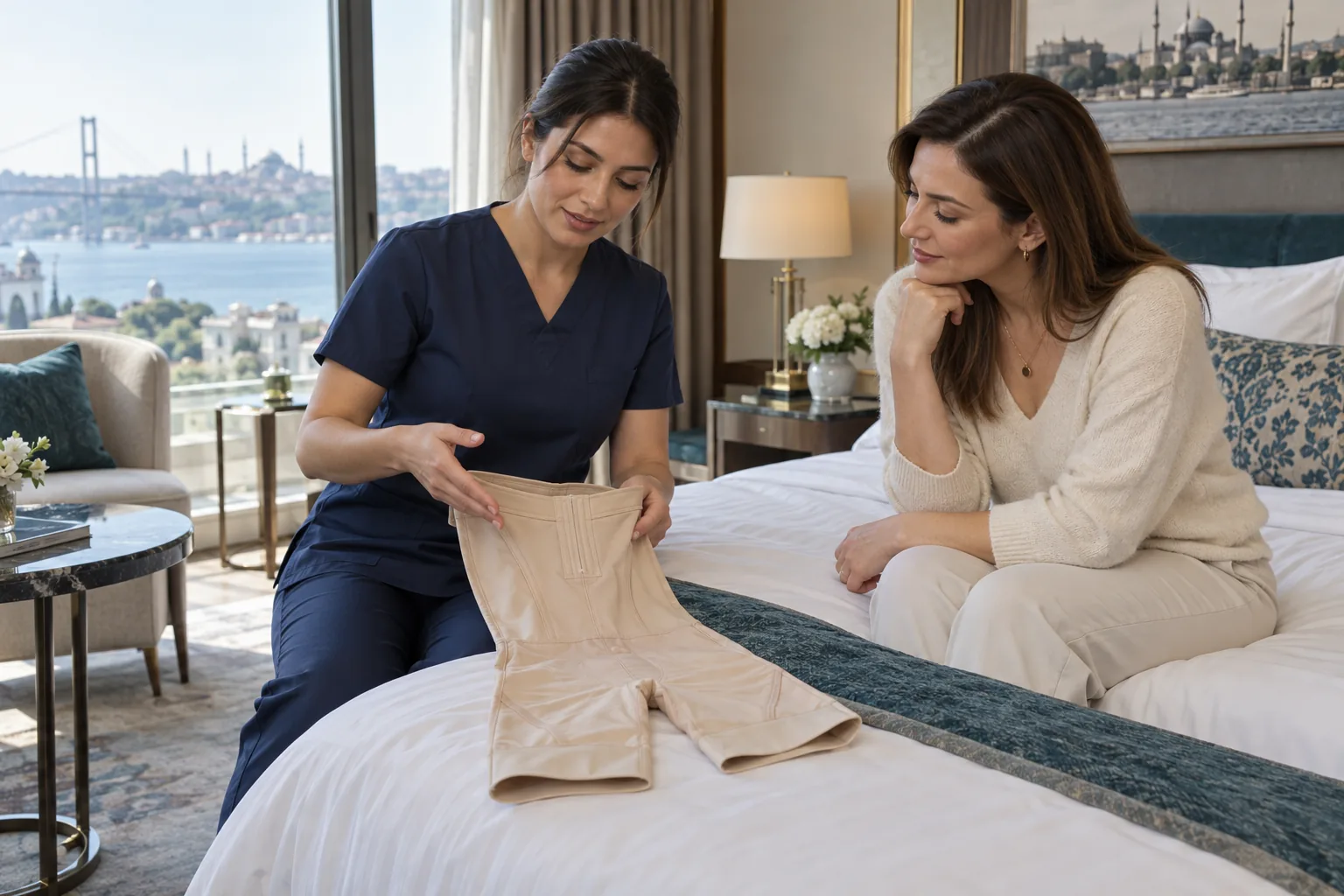
Help with a prescribed compression garment can be arranged during an Istanbul stay. Garment choice and wearing instructions remain with your surgical team.
Ask about nursing or companion support at your hotel
Roles explained clearly
Nursing tasks and non-clinical companion support are discussed separately.
Plan-based coordination
Clinical tasks may require instructions from the treating team.
24/7 request line
WhatsApp and phone requests are accepted 24/7; the requested role and schedule remain subject to availability.
PRICING & SUITABILITY
Before you book
Quoted fee
The role, schedule, included tasks and quoted fee are confirmed before booking.
Nursing and companion roles
Clinical nursing tasks and non-clinical companion support are defined separately.
Recovery expectations
Aftercare supports an agreed plan but cannot guarantee recovery speed or outcome.
A compression garment can be difficult to put on after an operation, particularly when reaching, bending or pressure over an incision is restricted. CNR Medicare coordinates support with the item and instructions your surgeon supplied. A provider can help with practical handling and flag concerns; the surgeon decides garment type, use and changes.
Which garment and instructions apply to your operation?
The garment specified after surgery is part of an individual plan, not a product to choose by appearance. Share the exact item, treated area and your surgeon’s written wearing instructions with the proposed provider. Tell them whether the difficulty is fastening it, positioning it over padding or following the routine while movement is restricted. A visiting helper cannot decide which compression level or design is appropriate.
CNR Medicare coordinates the request and a suitable provider assesses the support needed. If the garment was not supplied, is damaged or differs from the written plan, ask the treating team what to use. Do not copy another patient’s garment schedule or change to a different stage because a travel date is approaching. The original surgeon’s instructions remain the governing source.
What fit concerns should be described before a visit?
A garment should sit as directed by the surgical team. Folds, rolled edges, loose areas and concentrated pressure may matter, but the provider needs the actual item and the patient’s symptoms to assess a concern. Explain where the garment feels wrong and whether the problem appeared after a change in swelling or movement. A photograph may help identify the issue without replacing examination.
Severe pain, altered sensation, skin color change or a garment that suddenly fits differently should be reported to the treating team. Do not cut or alter the fabric to solve the problem independently. The provider may help position the item within the existing instructions or advise a clinical review when fit cannot be corrected by ordinary handling.
How can help with applying and removing it be arranged?
Putting on or removing a compression garment can involve reaching across an incision or bending against a restriction. Describe the movements the patient can and cannot make before arranging assistance. If hooks, zippers or panels are difficult, show the provider the exact closure rather than assuming it works like another garment. Any padding or dressing under the garment follows its own surgical instruction.
The helper should work with the patient’s consent and comfort, allowing the patient to do the parts they can manage. Assistance with washing or clothing may be a separate practical service. If removal for bathing is unclear, ask the surgeon; a helper should not invent a break in wearing time because it is convenient for the hotel routine.
What changes in swelling or skin need review?
Swelling can change during recovery, so the same garment may feel different on another day. Record what changed and when, including new pressure marks or irritation near an incision. A provider can observe the fit and report a concern, but the treating team decides whether the product, size or schedule should change. A tight sensation should not be dismissed as proof that compression is working.
Skin checks may be part of the surgeon’s plan, especially at closures, edges and areas of friction. Tell the provider if adhesive, padding or a dressing also touches that area. Do not apply an unapproved cream or add improvised padding beneath the garment. These changes can affect the fit and wound-care plan.
How does garment help fit a hotel stay?
For a visit at a hotel or residence, give the provider the room access instructions, a private space and the garment that must be handled. If the patient is recovering alone, explain whether they can reopen and refasten it without help after the appointment. The plan should address the real daily task rather than an isolated demonstration.
Travel may involve prolonged sitting, luggage and a different place to wash. Discuss these practical constraints with the treating team without changing the prescribed routine on your own. If the garment becomes unusable during the trip, ask the surgeon or clinic which replacement is appropriate before buying a similar-looking item.
When discussing a fit concern, explain what the patient was doing when it appeared and whether it changes on standing, sitting or moving. If the garment sits over a wound or drain, include that information so the provider can consider the full care plan. A practical helper can report that a closure is difficult or fabric is damaged; the surgeon or treating clinic decides whether the garment needs a different size, design or use instruction. The response should be based on this patient’s operation and current condition.
When should the surgical team reassess the plan?
A sudden or persistent fit problem belongs with the treating surgical team, particularly when accompanied by pain, numbness, skin changes or a wound concern. The provider may document the issue and help communicate it, but should not decide a new compression stage or tell the patient to stop prescribed use without clinical direction.
Before booking, confirm the exact help requested, provider role, location and cost. CNR Medicare coordinates the arrangement while the provider assesses what is appropriate.
1Step 1: Contact CNR Medicare with your Istanbul location, preferred language, surgery details, garment type and the written compression instructions provided by your surgeon or clinic.
2Step 2: Explain whether you need help putting the garment on, removing it, checking positioning, managing folds or reviewing a fit concern.
3Step 3: Confirm the support provider, appointment location, available time, required garment supplies, surgeon instructions and total proposed price before the visit.
4Step 4: During the appointment, the garment is applied or reviewed according to the treating team's instructions, with attention to positioning, even distribution and any symptoms suggesting that the fit needs reassessment.
5Step 5: Continue following the surgeon's wearing schedule and contact the treating team if fit changes, significant discomfort, altered sensation, color change or another concerning problem develops.
CNR Medicare coordinates medical services for visitors in Istanbul. We are not a hospital or a clinic: examination, treatment and laboratory analysis are carried out by the licensed health professionals and partner facilities we work with.
Send your request
Leave a contact number and a brief request. The team will clarify the proposed arrangements with you.
At your location
Frequently asked questions
What is Compression Garment Support?
Compression Garment Support provides practical help for post-surgery patients who have been instructed to use a corset or medical compression garment, including application, removal, positioning and fit-related support.
Can CNR Medicare decide which compression garment I should wear?
The garment type, size, pressure level and wearing schedule should come from the surgeon or responsible treating team. CNR Medicare coordinates practical support based on those instructions.
What if my compression garment feels too tight?
New pain, numbness, tingling, significant pressure marks or color change can indicate a fit problem. Contact the relevant healthcare professional for reassessment rather than independently increasing or changing the compression.
What if my garment becomes loose as swelling decreases?
A noticeably loose garment may need reassessment. Contact the treating clinic to ask whether another size, garment stage or fitting is appropriate.
Can someone help me put the garment on at my hotel?
Yes, practical garment application assistance can be coordinated at an Istanbul hotel, Airbnb or residence when the requested support and provider arrangement are confirmed.
Should I wear my postoperative compression garment while sleeping?
Follow the instructions provided for your specific operation. Night-time use differs between procedures and garments, so do not copy another patient's routine.
Can I roll or fold the edge if the garment feels too long?
Rolling or folding can create concentrated pressure. Redistribute the fabric as instructed and contact the treating team if the garment repeatedly appears too long or fits incorrectly.
How should I wash my compression garment?
Follow the manufacturer's washing and drying instructions because heat, detergent and handling can affect the fabric and elasticity. Ask the treating clinic or supplier if those instructions are unavailable.
When should my compression garment be replaced?
Replacement depends on the garment, wear, fit changes and postoperative plan. Ask for reassessment if the material stretches, closures fail, the garment becomes damaged or the fit changes significantly.
How do I arrange Compression Garment Support with CNR Medicare?
Contact CNR Medicare with your Istanbul location, preferred language, surgery details, garment type, written instructions and the help you need. The team can coordinate the support provider, appointment details and proposed price before confirmation.
Need help right now?
Contact us to discuss your request and check service availability.