Skip to content
CNR Medicare

Accessible Services

Hotel Assistance in Istanbul

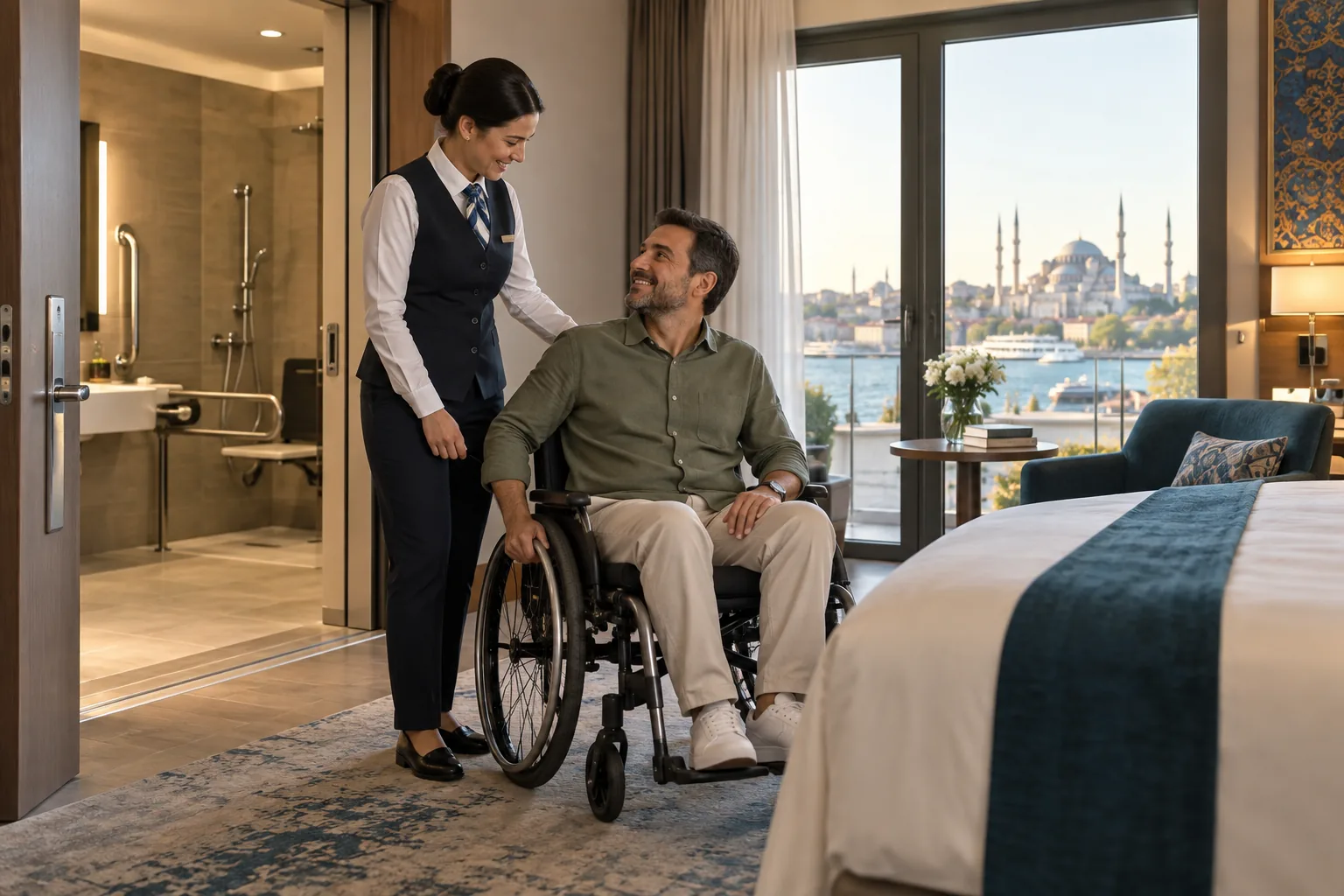
Photo illustrating Hotel Assistance in Istanbul
  • English speaking

CNR Medicare coordinates hotel assistance in Istanbul for wheelchair users and travellers with reduced mobility who need practical support during their stay. Room access, movement around the property and day-to-day assistance are planned around the guest's specific requirements.

Explain the barrier in the hotel journey

Hotel assistance begins before the traveller reaches the room. The problem may be an entrance with steps, a long distance from the vehicle, a reception process that is difficult to manage alone or a room that does not support the traveller's mobility aid. Tell CNR Medicare which stage creates the difficulty and what the traveller can manage independently. A request for an accessible hotel is too broad to establish whether the actual entrance, lift, bathroom and bed arrangement will work. The coordination team can help clarify questions with the accommodation and arrange separate support where available.

The hotel is responsible for confirming its own building and room features. CNR Medicare coordinates communication and practical services, but cannot certify an accommodation feature from a general description. If you have not booked yet, ask the property to confirm the specific room and route from the entrance. If you have already booked, share the booking details and the features that matter most. A written answer about the actual room is more useful than a general accessibility badge. Keep any uncertainty visible while deciding whether another room or property is needed.


Check the complete route to the room

Describe how the traveller will arrive, whether a wheelchair or walker will be used, and whether help is needed between the vehicle and reception. Ask the hotel about the drop-off point, entrance, any steps or ramps, lift access and the path to the allocated room. A step-free lobby does not establish that a guest can reach the bathroom, restaurant or exit without barriers. If the traveller remains in a wheelchair, the chair's dimensions may be relevant to doors and turning spaces; share verified specifications where possible and ask the property to confirm them against the actual room.

Inside the room, consider the tasks the traveller expects to do: getting into bed, using the bathroom, storing equipment and leaving without an access barrier. The hotel may be able to describe fittings or provide photographs, but the traveller should assess whether those details meet their needs. Do not assume a roll-in shower, grab rail or particular bed height exists unless the property confirms it. If the room is unsuitable on arrival, report the precise obstacle to hotel staff and contact the coordination team about any linked service. A companion or rented device cannot necessarily remedy a structural barrier.

Coordinate arrival and departure support

Airport pickup, accessible transport and assistance inside a hotel are separate parts of the journey. State where a driver should meet the traveller and where a companion, if arranged, will take over. Confirm who handles luggage and whether help is required with check-in or navigating to the room. A driver should not be assumed to assist with transfers or remain at the hotel after drop-off unless that is part of the agreed service. The hotel also needs to know about any equipment delivery, especially if the traveller arrives before a rental wheelchair or other item.

Plan the return journey with the same care. A checkout time, equipment collection and airport transfer should not conflict. Tell each provider if an appointment or flight changes the schedule. Ask the hotel where an accessible vehicle can stop for pickup and whether staff assistance has to be arranged in advance. If the traveller needs someone to accompany them through the lobby or to the vehicle, specify that task rather than assuming the transport booking includes it. A clear handover helps avoid gaps at the beginning or end of a stay.

Separate practical help from nursing and medical care

Hotel assistance can cover communication and practical arrangements, but it does not turn hotel staff or a travel companion into healthcare professionals. If the traveller needs wound care, injections, medication administration or monitoring after a procedure, discuss those needs with the treating clinician and the relevant hotel nurse or aftercare service. The clinician's written instructions take priority over a convenience plan. Ask what accommodation conditions are required for the clinical service, but do not treat a hotel room as suitable for a procedure until the provider has assessed it.

A mobility limitation and an acute health problem also require different responses. If a traveller has become newly weak, confused or unable to transfer because of illness, seek a medical assessment rather than adjusting the hotel booking alone.

Confirm what the property and each provider will do

List the hotel features that have been confirmed for the actual room and date, and identify anything still awaiting an answer. If a companion, wheelchair or accessible transfer is proposed, review its provider, start and end points, duties and cost separately. A single message saying assistance is arranged may hide uncertainty about which party is responsible for the doorway, luggage or equipment. Ask for a written plan that matches each need to a provider. The property should confirm the room and building; the equipment provider confirms the item; the transport provider confirms the vehicle.

Clarify whether hotel assistance includes help at check-in, wayfinding, a contact person or another practical task. A companion's language and availability should be confirmed, not inferred from the website. Review any additional charge, deposit, collection or cancellation term before accepting the complete proposal. If a promised hotel feature cannot be supplied, ask what alternative the property offers and whether it actually addresses the traveller's stated need. CNR Medicare can help coordinate the conversation, but the traveller should approve changes that affect their stay.

Recheck access when the booking changes

Send the location, booking dates, property details, allocated room if known, mobility equipment and the exact assistance needed. The coordination team can ask the relevant hotel and service providers to confirm a workable arrangement. An enquiry is not a confirmed accessible room or support booking. Keep the hotel's written feature confirmation and the separate provider details available when travelling. At arrival, compare the actual route and room with what was agreed and report a mismatch promptly rather than trying to manage an unsuitable space throughout the stay.

A room move, change of hotel, additional companion or replacement wheelchair can alter the access plan. Tell every affected provider before the next transfer or service begins. If the hotel offers a different room, ask it to confirm the same critical features again. If the traveller's clinical needs have changed, seek advice from the treating clinician and reassess whether practical hotel support is enough. The aim is an accommodation plan the traveller can use in reality, with each important detail checked by the party responsible for it.

How it works

  1. Describe your hotel assistance needs: Contact CNR Medicare with your hotel or accommodation details, travel dates, preferred language and a brief explanation of the access or mobility support required.
  2. Share mobility and travel details: Provide relevant wheelchair or mobility-aid information and explain which hotel features or types of assistance are essential for your stay.
  3. Check the proposed provider arrangement: The requested access features and support arrangements are reviewed with the relevant accommodation or service provider before confirmation.
  4. Use the agreed practical support: Review the confirmed hotel access details, assistance included, schedule and total proposed price before accepting the arrangement.
  5. Review changes and next steps: During your stay, contact the coordination team if your room, mobility needs, accommodation or requested support changes.

CNR Medicare coordinates medical services for visitors in Istanbul. We are not a hospital or a clinic: examination, treatment and laboratory analysis are carried out by the licensed health professionals and partner facilities we work with.

Send your request

Leave a contact number and a brief request. The team will clarify the proposed arrangements with you.

At your location

Frequently asked questions

What does Hotel Assistance include?

Hotel Assistance focuses on practical accessibility during the stay, including room-access planning, movement around agreed hotel areas and coordination of specific mobility-related support.

Can CNR Medicare check whether my hotel room is wheelchair accessible?

The relevant access features can be discussed with the accommodation, but suitability should be confirmed against your specific wheelchair and mobility requirements rather than a general accessibility label.

Can you help with bathroom accessibility?

Bathroom features such as step-free access, grab rails, shower configuration and manoeuvring space can be included in the questions that need confirmation before the arrangement is accepted.

Can Hotel Assistance help me move around the hotel?

Movement support can be discussed for agreed areas such as the room, lobby and hotel entrance. The exact assistance provided should be confirmed before booking.

Can a wheelchair be delivered to my hotel?

Wheelchair rental can be coordinated separately through the relevant Accessible Services option, including delivery and collection arrangements when available.

Can you arrange accessible transport from my hotel?

Yes. Accessible transfers can be coordinated separately when the required vehicle features, wheelchair details and route have been confirmed.

Is Hotel Assistance the same as a personal companion?

No. Hotel Assistance focuses on accommodation-related access and practical support. A Personal Assistant / Companion service is more appropriate when ongoing one-to-one accompaniment is required.

Can you support me if I am staying in an Airbnb or serviced apartment?

Yes. Practical accessibility support can also be discussed for Airbnbs, serviced apartments and residences, although the available features depend on the individual property.

Is the service confirmed as soon as I send a WhatsApp message?

No. Your request is reviewed first. The arrangement is confirmed after the specific assistance, access features, provider details and price have been agreed.

Need help right now?

Contact us to discuss your request and check service availability.

Updated

Send a request